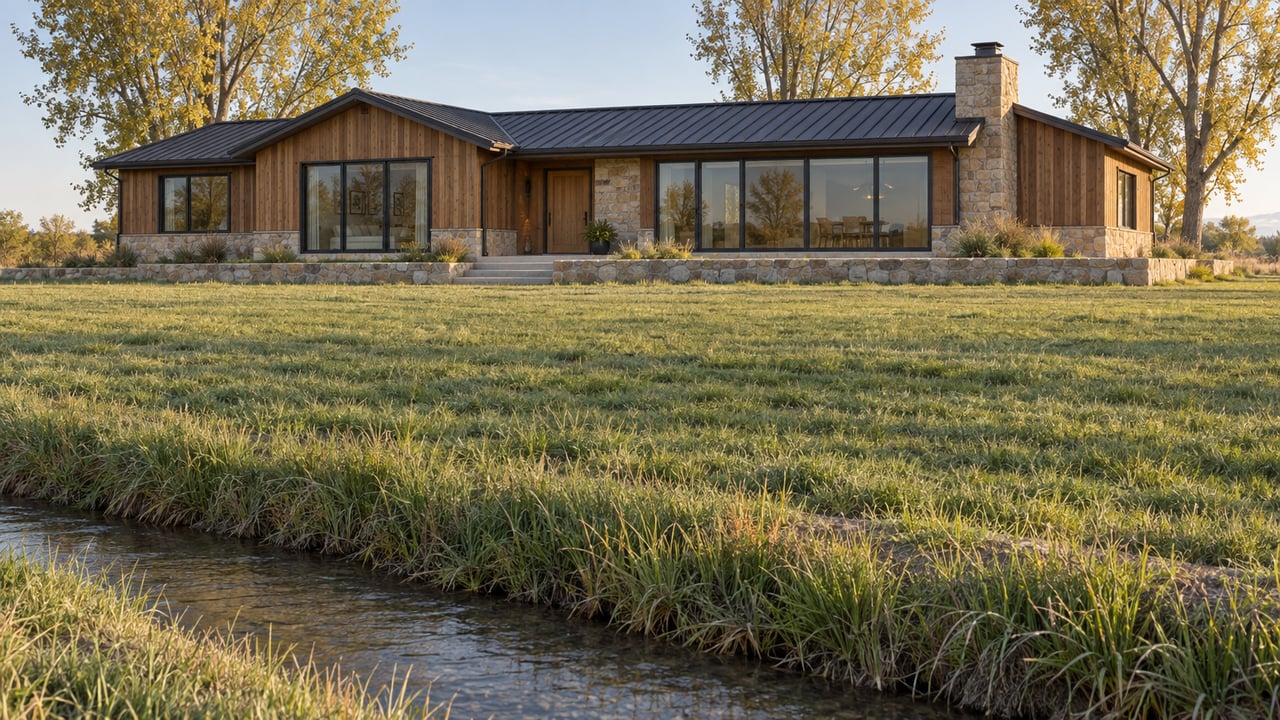
As Aspen Daily News reported, a ranch beneath Mount Sopris, a few miles outside downtown Carbondale, is on the market for $15,995,000. George Stranahan bought the property in the early 1970s and brought in Richard McIntyre to run it. In 1981, the two men donated the first conservation easement ever held by the Aspen Valley Land Trust, a document that would go on to shape how thousands of acres across the valley are protected. The ranch still produces hay today, using regenerative practices on ground that has stayed agricultural for more than a century.
None of that is what sets the price. What sets the price is a piece of paper most buyers never think to ask about first: 168 shares in the East Mesa Ditch, carrying a water right decreed in 1886.
That single fact does more to explain the number on this listing, known as Flying Dog Ranch West, than any acreage figure could. And it points to something buyers comparing land near Carbondale consistently get backward. They shop for size first and water second, when in this valley the order should run the other way.
Same Word, Two Different Assets
Drive twenty minutes up onto Missouri Heights, the mesa above Carbondale where much of the valley's old ranch and farm ground has been subdivided into large-lot residential parcels, and you'll find bare acreage in roughly the same size range as Flying Dog Ranch West's irrigated ground. Recent sales in that area put vacant 10 to 35 acre parcels in the $1 million to $1.6 million range, and a meaningful share of those parcels carry no water rights adequate to irrigate the land in any real sense.
Set the two side by side and the difference stops looking like a matter of degree.
| Flying Dog Ranch West | Typical bare Missouri Heights parcel | |
|---|---|---|
| Irrigated ground | Roughly 180 acres beneath Mount Sopris | Often none |
| Water rights | 168 shares, East Mesa Ditch, 1886 priority, 7 cubic feet per second | Frequently absent or insufficient for irrigation |
| River frontage | Quarter mile on the Crystal River | Typically none |
| Conservation status | Held under a 1981 Aspen Valley Land Trust easement | Usually unrestricted |
| Recent asking or sale range | $15,995,000 | $1 million to $1.6 million |
Both properties would show up in a search filtered by acreage and Mt. Sopris views. That's the difference the acreage number can't show you, and it's the difference that actually prices the land.
Water and the Value of Bare Acreage
This is also why bare Missouri Heights acreage prices so differently. Its agricultural and long-term development potential depends on whatever water can still be found, permitted, or purchased separately, often at a cost that dwarfs what the land itself sold for.
The Water Doesn't Come Without the Ditch
Owning shares in a ditch company is only half the picture. The other half is the physical ditch.
The Colorado Supreme Court took up exactly this problem in a case involving a 240-acre agricultural ranch near Basalt. The ranch, operated by St. Jude's Company, shared three irrigation ditches with an upgradient neighbor that had converted its own former agricultural land into a private golf and fly-fishing club. The club, wanting to build cabins and greens, altered the ditches without the ranch's consent, regrading banks, piping sections, and building over parts of the easement. The court found the club had committed trespass. Its ruling established that a ditch easement can't be unilaterally moved or altered by whoever happens to own the land it crosses, no matter how minor the change or how much it might benefit the ranch too.
That case is now a quarter century old, but the principle it settled hasn't changed, and it's exactly the kind of friction that surfaces during due diligence on ranch and acreage deals across this valley. A senior water right is only as good as the physical infrastructure that delivers it, and that infrastructure often crosses a neighbor's ground under an easement nobody has looked at closely in decades. Before a buyer prices a parcel for its water, someone needs to confirm the ditch itself is documented, maintained, and free of unresolved disputes with whoever's land it crosses.
What the Valley's Water Has Historically Cost
Reporting on Roaring Fork water sales has historically put ditch shares in the range of $1,500 to $10,000 per acre foot, depending on how senior and how scarce the right is. Compare that to the Front Range, where fast-growing communities like Douglas County have paid $25,000 to $35,000 per acre foot for water supply, and the Roaring Fork Valley starts to look like a place where senior agricultural water is still priced well below what water-stressed corridors on the other side of the Divide are already paying for the same resource.
That gap matters for anyone thinking about a ranch purchase as a long-term hold rather than a single transaction. Colorado's statewide average farm real estate value sat at $2,290 per acre in 2025, a figure that says almost nothing about what a Roaring Fork Valley ranch with senior water actually commands. Industry reporting from earlier this year continues to place this valley at the top of the state's ranch price points, and the reason isn't the scenery alone. It's that scenery, agricultural water, and river frontage rarely come bundled together anywhere else in Colorado, and demand for that specific combination hasn't slowed.
For a family thinking in decades rather than years, water that trades well below what other Colorado markets already pay for the same category of asset is worth more attention than the acreage total on the listing sheet.
Questions That Matter More Than the Plat Map
Anyone comparing ranch or acreage parcels near Carbondale gets a clearer picture by asking about the water before asking about the house, the barn, or the boundary lines. That means requesting the ditch company shares and confirming they transfer with the sale, checking the decreed priority date against other users on the same ditch, and reviewing whether the water is limited to irrigation use or carries broader decreed purposes. It means asking whether a well on the property requires an augmentation plan before it can be reliably used. And it means finding out whether the physical ditch crosses any neighboring parcel under an easement, and whether that easement has ever been the subject of a dispute like the one the Colorado Supreme Court resolved near Basalt.
None of these questions show up on a standard property search filtered by acreage and price. These are due-diligence questions for anyone considering ranch ground here.
FAQ
What should a buyer review about water during a ranch sale? Water rights and related records deserve careful attention. Ditch company shares, well permits, and decreed water rights should be reviewed during due diligence.
How does a buyer check a ditch's priority date before making an offer? Colorado water rights are adjudicated through the water court system, and decrees are public record through the state's Division of Water Resources. A priority date, decreed amount, and permitted use can all be confirmed before closing, and any responsible offer on ranch or irrigated acreage should include time to do exactly that.
Ranch and acreage deals near Carbondale rarely fail over the price of the dirt. They stall or unwind over water that turned out to be smaller, junior, or more encumbered than expected. If you're comparing parcels in this market and want someone to read the ditch records and easement history before you write an offer, not after, Gabe Molnar has spent 25 years pricing exactly this kind of Colorado ground. Let's Connect.
This article is general information, not legal, tax or financial advice. Consult a qualified professional about your situation.